
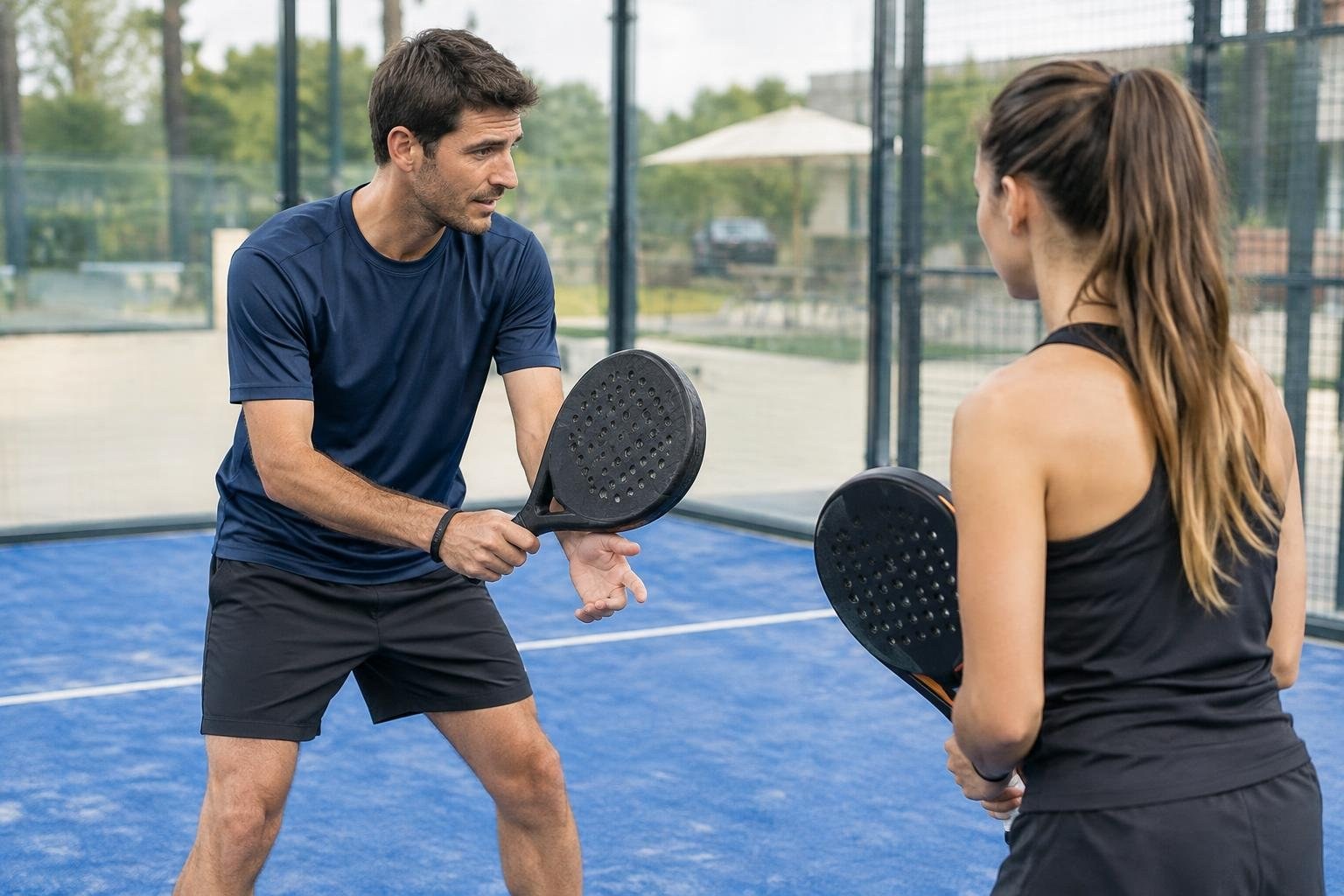
Your first time playing padel is usually less about hitting winners and more about learning how the racket, walls, scoring and teamwork fit together. A beginner lesson or clinic can introduce grip, basic strokes, serving, scoring and court position; some sessions also include time to rally or play points. You do not need to arrive as an experienced tennis player. Before booking, check what the session covers, whether a racket is available to borrow and what footwear the club recommends. Then give yourself permission to make mistakes: at the start, a controlled ball and a clear call to your partner are more useful than a powerful shot.
What to know before your first time playing padel
Padel is a racket sport played on an enclosed court where the walls are part of the game. For a new player, that changes the first impression: a ball that passes you may still be playable after it rebounds, so there is a moment to judge its path rather than immediately giving up on it. Beginner guides commonly recommend learning the fundamentals before worrying about advanced shots.
You can start with a lesson, a group clinic or an introductory game. A lesson is useful if you want a coach to explain technique and rules; a social game may suit you if the group is specifically welcoming to beginners. Either way, tell the organizer that you are new. That helps set expectations and makes it easier to ask questions during play.
Your first goal is not to master padel in one visit. It is to understand the basic rhythm: serve, return, rally, communicate and reset for the next point.
What a beginner padel session includes
A beginner session is an introduction, not simply a court booking. A coach-led lesson may cover how to hold the racket, make basic strokes, serve, understand scoring and position yourself. Some introductory lessons are described as lasting 30 to 60 minutes, but session length and structure vary. Confirm what your particular booking includes.
Ask whether the coach will demonstrate each skill, whether you will practise with a partner and whether the session includes points or a short match. If it is a group clinic, check the group size and how much individual feedback to expect. A clear description should tell you whether the booking is instruction, court time or a combination.
Do not worry if you need to pause to ask about a rule or repeat a movement. It is easier to learn when you understand why a shot or position is being suggested, rather than trying to copy it without context.
Signs you may benefit from a lesson or beginner clinic
Consider a beginner lesson if the rules feel unfamiliar, you are unsure how the walls work or you would like a coach to help you start. A structured session can bring several basics together, including grip, stroke technique, scoring and positioning. It can also be a more comfortable first step than joining a game where the other players already know one another.
A lesson is not your only option. If you have played before and feel comfortable learning by doing, a beginner-friendly social game may be enough. Check that the activity really is suitable for beginners; a listing that simply says “social” may not explain the players’ experience level or how much instruction is available.
If you feel lost once rallies begin, that is useful information, not a reason to give up. Try a coach-led session or ask for a brief explanation of the serve, scoring and court positions before your next game.
Cost and pricing: what to check before you book
Padel session costs depend on what and where you book. Do not assume a lesson, clinic, court rental and social game are interchangeable prices. Compare the total cost of the activity you actually want, rather than relying on a headline figure.
Before paying, ask whether the fee covers coaching, court time, equipment and any other stated items. Check the session length, group size, cancellation terms and whether a rental racket costs extra. If you are comparing a private lesson with a group clinic, consider both the price and the amount of coaching time you are likely to receive.
Look at the booking details for the specific club and date. If a price is unclear, ask the provider to confirm the full charge before you reserve a place. Avoid making a purchase decision based on an old price or a claim that does not clearly apply to your location.
Practical factors that shape your first-session plan
Several practical details shape your first-session plan: whether you book a private lesson, group clinic or social game; how long it lasts; which basics it covers; how much time is set aside for play; and what equipment is included. Beginner lessons can cover grip, stroke technique, scoring and positioning, while an introductory lesson may last 30 to 60 minutes. Check the specific booking rather than assuming every session offers the same format or length.
Your previous experience also helps determine where to start. If you have played tennis or another racket sport, tell the coach, but explain that you are new to padel. If you have no racket-sport experience, say so; beginner guidance covers fundamentals such as grip, serving and court position.
Equipment arrangements and footwear recommendations can affect what you need to bring. Ask whether a racket is available to borrow or rent, whether balls are supplied and what footwear the provider recommends. Confirm these details before you book so your plan matches the session.
Compare a lesson, clinic and beginner social game
Three common ways to begin are a private lesson, a group clinic and a beginner-friendly social game. Each has a different balance of instruction and play. A private lesson may give you more direct attention; a group clinic can combine instruction with practice alongside other newcomers; a social game may offer more time playing but less formal teaching. Check the actual session description before deciding.
| Option | May suit you if | Ask before booking |
|---|---|---|
| Private lesson | You want individual instruction | What skills and playing time are included? |
| Group clinic | You like learning with other beginners | How many players will attend? |
| Social game | You want to try playing in a relaxed setting | Is it genuinely beginner-friendly, and will anyone explain the format? |
There is no one best option for every newcomer. Choose based on how much explanation you want, your comfort in a group and the cost and length of the specific booking.
What to expect and how long a first session takes
For a first visit, think in three stages: check the booking, learn a few basics and finish with a clear next step. An introductory lesson may last 30 to 60 minutes, but your own session could be shorter or longer. Ask about its duration and whether changing, warm-up or playing time is included.
- Before you go: Confirm the time, location, session format, equipment and footwear requirements.
- At the start: Tell the coach you are new and ask for an explanation of the serve and scoring.
- During play: Aim for controlled contact, watch the ball and communicate with your partner.
- Afterward: Note what still feels unclear and ask what to practise next.
A first match may feel busy because you are learning the ball, court and score at once. Take one point at a time. You do not need to remember every tactical idea immediately.
Scoring, positioning and simple first-match tactics
Padel uses a familiar point sequence: 15, 30, 40 and game. At 40-all, called deuce, the cited beginner explanation says a team must win two points in succession to take the game. Its description of a standard set says a team reaches six games with at least a two-game lead. Confirm the format for your session, because local organizers may explain how their activity is scored.
As a beginner, focus on three simple choices. First, return the serve safely rather than trying for a winner. Second, keep the ball in play with a controlled shot. Third, talk with your partner: short calls such as “mine” or “yours” can help avoid both players going for the same ball.
Move forward as a pair when you have a good opportunity to approach the net, and be ready to adjust together if the other team sends you back. Do not rush forward automatically after every shot; ask your coach to show you when the move makes sense for your level.
How to get comfortable with the walls
Padel’s walls are not just boundaries. Beginner guidance encourages players to learn to use them rather than fear them. In practice, watch how the ball travels and give yourself time to decide whether it is playable after a rebound. At first, you may misjudge the bounce. That is normal: a coach or more experienced partner can help you read the ball and choose a safe response.
A beginner tip is to position yourself near the back wall when learning to defend, because it can give you more time to read and react to the ball. Treat this as a starting point rather than a fixed rule for every rally. Your position will change as the ball and your opponents move.
Most importantly, do not swing wildly at a ball you have not read. Let it travel when appropriate, stay balanced and make a controlled return. Your aim early on is to keep the rally going and understand the rebound, not to attempt difficult shots.
What to bring and what to wear
You do not need to buy a full equipment kit before trying padel. Beginner advice suggests asking whether you can borrow or rent a racket, then wearing trainers with good grip. Another beginner guide recommends learning the basics before deciding what equipment you need. Confirm what the club provides and what you must bring.
- Wear comfortable sports clothing and grippy trainers.
- Ask whether a racket is included, available to borrow or available to rent.
- Check whether balls are supplied.
- Bring water and arrive with enough time to find the court.
- Save the booking confirmation and the provider’s contact details.
If you enjoy the first session, use what you learned to guide a later racket purchase. Try to understand what feels comfortable in your hand and ask a coach for advice based on your level. A beginner does not need to buy equipment simply because it is marketed as essential.
How to choose a qualified coach or provider
Choose a provider that clearly describes the session as suitable for beginners and explains what instruction it includes. A credible booking description should make it possible to understand the format, length, price and equipment arrangements before you commit.
Ask who will lead the session and what experience or coaching credentials they have. Some clubs describe their beginner instruction as led by certified coaches, but that claim should be checked with the particular provider; do not assume every lesson has the same coach qualifications. You can also ask whether the coach has experience introducing complete beginners to the game.
Look for straightforward answers about group size, court access, cancellation terms and safety expectations. If a provider cannot explain what you are booking or pressures you to pay before clarifying basic terms, compare other options. There is no need to select a coach based on promotional language alone.
Safety, credentials and booking terms to check
Ask the club about its own safety and booking requirements rather than assuming that every venue follows the same process. Check which footwear is accepted, whether the court is suitable for your session and what to do if you have a concern. If you have an injury or health question that may affect participation, seek appropriate professional advice before playing.
For a coach-led booking, ask what qualifications the coach holds and whether the provider can explain them. Confirm whether any equipment is supplied and inspect borrowed equipment before use. Read the booking and cancellation terms so you know what happens if plans change.
Do not treat a general beginner guide as a substitute for venue-specific rules. Ask the club directly about applicable rules and any written terms tied to your booking.
How to save without compromising your first session
The simplest way to keep your first session economical is to avoid buying equipment before you know what you need. Ask about borrowing or renting a racket, and compare the full cost of a group clinic, private lesson or social game. A lower headline price is not necessarily the better value if it excludes the instruction or court time you want.
Check whether the provider offers an introductory session and read what the offer includes. Do not assume a “free” or discounted booking covers equipment, additional court time or future sessions. Confirm the final terms before reserving.
Save safely by choosing the right level of service, not by ignoring footwear requirements or booking terms. If you are uncertain whether you need coaching, try one clearly described beginner session before committing to a package. Compare options on session length, coaching, group size and included items.
Beginner mistakes, red flags and a booking checklist
Common first-session mistakes are understandable and fixable. Trying to hit every ball hard makes control harder; instead, aim for a comfortable contact and a ball you can keep in play. Ignoring the walls removes a useful part of the game, so watch the rebound and ask how to respond. Standing still after your shot can also leave you unsure where to go next; pay attention to your coach’s positioning advice.
Before booking, use this checklist:
- Is the session explicitly suitable for beginners?
- What skills, playing time and session length are included?
- Is it private, a group clinic or a social game?
- Is a racket available to borrow or rent, and are balls supplied?
- What footwear and arrival instructions apply?
- What is the complete price and cancellation policy?
- Who is coaching, and what qualifications or experience can they explain?
Be cautious if the provider will not clarify the session format, total cost or equipment arrangements. A clear booking makes it easier to arrive ready to learn.
Frequently asked questions
What do you learn in a first padel lesson?
A first beginner lesson may cover grip, basic stroke technique, serving, scoring and court positioning. Ask the provider what is included, because session plans differ.
Do I need to buy a padel racket before my first session?
You can often start with a borrowed or rented racket, if the club offers one. Confirm availability before booking. Wear trainers with good grip and ask whether balls are supplied.
How long is a beginner padel lesson?
A beginner introduction may last 30 to 60 minutes, though the exact duration depends on the provider. Confirm the session length and whether playing time is included when you book.
How does padel scoring work for beginners?
Padel uses familiar tennis-style scoring: points progress through 15, 30 and 40. At deuce, a team generally needs to win two points in a row to take the game. Ask your coach to explain the format used at your session.
Can I play padel if I have never played a racket sport?
Yes. A beginner session is a practical way to learn the basics, even if you have not played a racket sport before. Tell the coach your experience level so the session can start at a comfortable pace.
Is a padel lesson or a social game better for a beginner?
Beginner sessions may be offered as a lesson, clinic or introductory social game. Compare the group size, coach involvement, session length, included equipment and total price before choosing.
People Also Ask
What should I expect at my first padel lesson?
A beginner clinic or lesson can cover grip, basic strokes, serving, scoring and court positioning. Confirm the exact plan, group size and playing time with the provider before booking.
Can I rent a padel racket for my first game?
Ask whether a racket and balls are provided, or whether the club has rackets to rent. If borrowing is available, it can be a practical way to try the sport before buying equipment.
What should I wear to play padel for the first time?
Wear comfortable sports clothing and trainers with good grip. Check with the club about footwear requirements and bring water. Ask in advance if anything else is needed for the session.
What is the best way to start learning padel?
Start by learning the basic scoring and serving routine, then focus on returning the ball safely and communicating with your partner. A beginner lesson can provide structured guidance.
Is padel scoring the same as tennis?
Padel uses 15, 30 and 40 point scoring, with deuce at 40-all. In the standard format described in beginner guides, a team needs a two-point advantage to win from deuce.
Should a beginner take a padel lesson or just play a match?
A first session can be a lesson, clinic or introductory match. A coach-led format offers instruction; a social game puts more emphasis on playing. Compare the session description and ask how much guidance to expect.
Your first time playing padel is a chance to learn the basics, not a test of athletic ability. A beginner lesson can help you get comfortable with the racket, serve, scoring and court positioning before you play a full match. Book a suitable session, ask what equipment is provided, wear grippy trainers and focus on keeping the ball in play. Once you understand how the walls and teamwork fit together, the game becomes easier to read. Explore more padel guides on mlpadel.com to compare your options and prepare for your next session.
Your next step
Explore padel apparel and the Major League Padel community.
Last reviewed and updated October 8, 2026 by the Major League Padel Editorial Team.
Sources
- How to Start Playing Padel: A Beginner's Guide | RSC
- How to Start Playing Padel: Beginner Guide (2026) | Corcuera
- Basic padel rules for beginners | Playtomic
- How to Play Padel: Rules, Scoring & First-Game Tips for Beginners | Padel Rules
- How to Play Padel: Complete Beginner's Guide 2026
- How-To Guides — padel.how
- How Do I Get Started Playing Padel? – Racket Central
- Padel for Beginners — Rules, Gear & Your First Match (2026 Guide) | Padel Rules