
Padel is a doubles racquet sport played on an enclosed court where the walls remain part of the rally. The rules are easy to pick up once you understand the serve, scoring and the key distinction between a ball bouncing on the court and one striking a wall or fence. This guide explains those fundamentals, common faults, equipment safety and practical ways to check the rules before a casual or organized match.
Padel rules at a glance: what every new player should know
Padel rules tell players how to serve, score, use the enclosed court and decide whether a rally continues. The essential features are an underarm serve, a ground bounce on the receiving side before the ball touches a wall or fence, and a racket with a wrist strap. For a complete match, players also need to know the scoring and fault rules used by their competition.
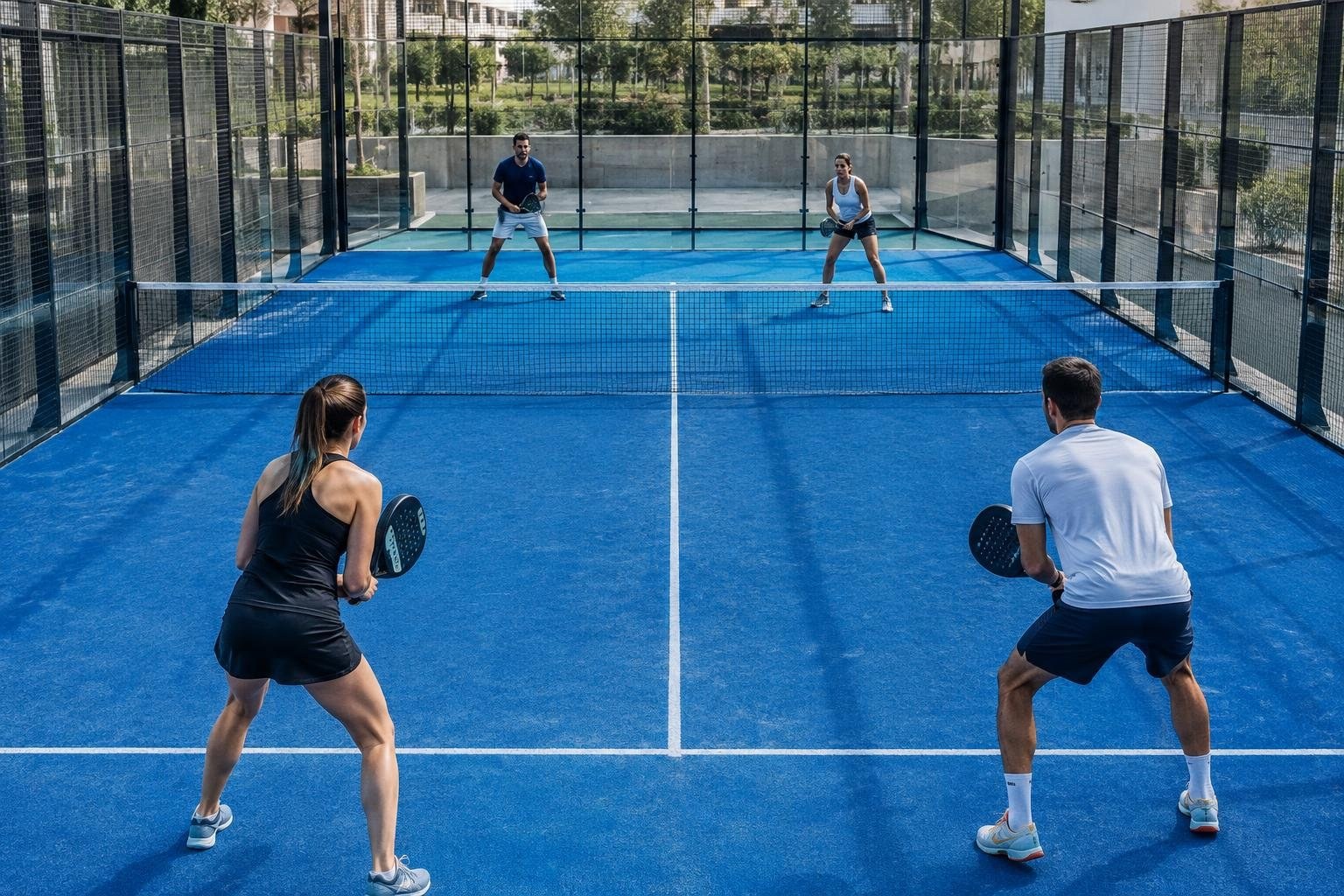
The court is 20 metres long and 10 metres wide, with a net across the middle. Walls and fencing enclose the playing area, but they do not make every ball that touches them legal. The order of contact matters: a ball must first bounce on the opponents’ court before it reaches their wall or fence. By contrast, a player can use a wall on their own side after the ball has bounced there.
That difference is the quickest way to understand wall play. The walls are part of the rally, not a substitute for the required ground bounce on the opponents’ side.
How padel scoring works
Padel scoring follows the familiar tennis-style pattern of points, games and sets. The score is called before each point, and partners should make sure they agree on it. If the score is disputed, stop and settle the question before serving again rather than continuing with different assumptions.
In casual games, confirm the match format before you start: how many sets or games you plan to play, and what procedure you will use if a set reaches a tiebreak. Competition regulations may specify the format and any permitted scoring variations. Do not assume that a social game and an organized event use identical match conditions.
For a tournament, use the rules supplied by the organizer or the relevant governing body. A complete rules resource covers scoring alongside serving, court use, faults and conduct; a short beginner summary may not include every detail needed to resolve a close call.
How to serve legally in padel
A padel serve is hit underarm and directed diagonally across the net into the opposite service box. A serve that does not land in the correct box is not valid.
After a serve bounces in the correct box, it may touch the glass, but touching the receiving-side fence after the bounce is a fault. Check the full rules and any event regulations for other service requirements and how to handle lets.
Practical check: aim diagonally into the service box and check the order of contact if the ball reaches the enclosure. If a serve clips the net, use the applicable let rule rather than guessing.
How wall and fence rules work during a rally
Once a serve is returned, the ball must cross the net and bounce on the opponents’ court before it hits a wall or fence. If it strikes their glass or mesh first, the shot is out. This bounce-first rule applies whether the player is hitting a groundstroke, volley or other shot.
On your own side, the sequence is different. After the ball bounces on the court, it may rebound from the glass or wall and still be played. That rebound gives players time to move into position and return a ball that might have been difficult to reach before the bounce. A ball may also be played before it bounces, but then it must be returned over the net without first hitting your own wall or fence.
In short, a wall can help you defend after the bounce on your side, but it cannot make an otherwise invalid shot legal on the opponents’ side. The fence is especially important on serve: after a serve bounces in the service box, contact with the receiving-side fence makes it a fault.
Common faults, lets and conduct to understand
A point can end when a player commits a fault. One common error is treating any ball that reaches the opponents’ glass as a good shot. It is only good if it first bounced on the opponents’ court.
The full rules cover faults and lets as well as scoring and wall play. In organized play, follow the applicable competition rules and the referee’s decision.
For recreational matches, agree before starting how you will handle uncertain calls. Be consistent, and replay a point only when the applicable rule allows it. Clear communication helps prevent avoidable arguments.
Signs you may need a padel rules refresher
A rule refresher is useful if you are new to padel, have played only casually, or are unsure what happens when the ball reaches the glass or fence. It is also worthwhile before an organized match if you do not know the event’s scoring format or service procedure.
- You or your partner disagree about whether the ball must bounce before reaching the wall.
- You are uncertain whether a serve that reaches the fence is valid.
- Players are using different assumptions about scoring, lets or faults.
- You are moving from social play to a competition with written regulations.
These are signs of a knowledge gap, not reasons to feel embarrassed. The fastest fix is to identify the disputed situation and consult a reliable rules resource. For recurring questions, review the full governing rules rather than relying only on what another player remembers.
Cost considerations when learning padel rules
There is no single price for learning the rules: this guide does not set fees for court hire, lessons or equipment. If you are comparing paid ways to learn, ask what the fee includes, whether court time and equipment are included, how long the session lasts and whether the instruction covers rules as well as technique. Get the full amount and cancellation terms before booking.
Separate the cost of rule knowledge from the cost of playing. A rules reference can help explain regulations, while a coached session or match provides a chance to practise them. Do not pay for a service based only on a promise that it will make you a better player; check its specific scope and what you will receive.
For equipment planning, remember that a padel racket differs from a tennis racket: it is shorter, has no strings and has a solid perforated face. Those features can help you identify the correct category when comparing products, but they do not establish a current price or prove that one racket suits every player.
What affects a rules decision during a match
The rules that affect a point depend on what happened, where it happened and in what order. Was the shot a serve or a rally ball? Did it bounce in the correct service box? Did it touch the ground before the wall or fence? Those details can change the call.
- Shot type: serving has its own requirements, including the diagonal service box and restrictions on fence contact.
- Contact order: a rally ball must bounce on the opponents’ side before reaching their wall or fence.
- Playing context: casual games can agree on a format, while organized matches follow their applicable regulations.
- Rule version: official rules and competition information may be updated, so check the applicable current version rather than relying on an old summary.
When a point is disputed, describe the sequence calmly. “It bounced in the box, then hit the fence” is more useful than simply saying a serve was good or bad.
Which padel rules resource should you use?
Choose the level of rules information that matches your need. A quick overview is useful for learning the central ideas, such as underarm serving and wall play. A full rulebook is the better reference for a competition or a disputed situation because the rules include more than scoring and the basic bounce sequence.
- Beginner summary: use it to learn the court, serve and basic rally logic.
- Complete official rules: consult these for detailed faults, lets, scoring, equipment and conduct.
- Event regulations: check these for the format and specific conditions of a tournament or league.
These options serve different purposes. A commercial equipment guide may explain a racket feature, but it should not replace the rule source for a rules question. The International Padel Federation’s rules are available through resources that reproduce or direct readers to the complete official rules; confirm the current version when precision matters.
What to expect when learning the rules
You can learn the basic rules before your first match, then reinforce them while playing. Start with the serve, the scoring format and the bounce-before-wall principle. During play, notice whether the ball bounced on your side before using the glass and whether your shot bounced on the opponents’ court before touching their enclosure.
There is no fixed learning timeline that applies to every player. If an issue appears repeatedly, pause between games and review that one rule. A short practical review is often easier to remember than trying to learn every unusual case at once. For tournament preparation, leave time to read the event’s regulations before match day.
A simple sequence is: read a beginner overview, play a casual match with a clear scoring agreement, note questions, then verify them in a full rules resource. This helps you distinguish the basic structure of the game from details that arise less often.
How to choose a qualified padel coach or rules resource
If you want instruction, look for a coach or program that can explain rules clearly and adapt the session to your playing level. Ask whether the session covers match rules, practical situations and any rules specific to the event you plan to enter. A good fit should welcome questions and be able to explain not just what the call is, but why it applies.
Do not assume that a title, online profile or confident claim alone proves a person’s qualifications. Ask what training or experience they have, what the session includes and whether you can speak with them before booking. The available rules sources explain regulations, but they do not establish a universal coach credential or certify a particular provider.
If your main goal is simply to understand a rule, begin with an authoritative written source. Consider paid instruction when you also want guided practice or feedback on how rules apply during play.
Equipment safety, credentials and what to verify
For safe play, use a padel racket and wear its wrist strap. Padel rackets are shorter than tennis rackets and have a solid face with holes rather than strings. One equipment source gives a typical racket weight range, but the best choice depends on the individual and the equipment specifications should be checked for the specific model.
Rules also cover equipment and conduct, so consult the applicable rulebook if you are entering a competition. This guide does not establish local permits, venue policies, coach licensing requirements or product warranties. Ask the facility or event organizer about its own conditions, and check a product’s written warranty before purchasing.
Do not treat a marketing description as a rule or a guarantee. Confirm equipment details with the manufacturer and distinguish general safety guidance from formal competition requirements.
Ways to save without compromising safety or clarity
You can avoid unnecessary spending by learning the basic rules from a reliable free or existing resource before booking a session. If you do pay for coaching, compare what each session actually includes rather than choosing by headline price alone. Ask about court time, equipment, session length and cancellation terms.
Borrowing or renting equipment may be an option at some facilities, but availability and fees vary, so confirm directly before you rely on it. If purchasing a racket, compare the features that are relevant to you and check the model’s details rather than paying extra for a claim that is not tied to your needs.
Save safely: do not skip the wrist strap or use equipment that is not suitable for padel just to reduce an upfront cost. A cheaper option is not worthwhile if it leaves you unclear about what is included or how the equipment should be used.
Common mistakes, red flags and a match-day checklist
Before your next match, use this quick checklist:
- Agree on the match format and how you will keep score.
- Remember that the serve is underarm and directed diagonally into the service box.
- On the opponents’ side, make sure the ball bounces before reaching the wall or fence.
- On your side, use the wall only after the ball has bounced on the court.
- Wear the racket wrist strap.
- For a competition, check the current full rules and event regulations.
Common mistakes include confusing a wall rebound on your side with a ball hitting the opponents’ wall first, forgetting the fence restriction on a serve, and relying on a social-game convention in a formal match. If a provider will not explain what a paid lesson includes, or cannot clarify the basis for a rules claim, pause and verify before booking. For close calls, use a current authoritative rule source instead of relying on memory.
How to check a disputed padel call
To check a disputed call, first identify whether the shot was a serve or a rally ball. Then follow the order of contact: did the ball bounce on the court before it reached a wall or fence? For a serve, also check whether it bounced in the correct service box and whether it touched the receiving-side fence.
These details help identify which rule applies. For a close call or organized match, consult the applicable full rules and event regulations rather than relying on memory or a general summary.
Key factors in a padel rules decision
To assess a disputed point, first identify whether the shot was a serve or a rally ball. Then check where the ball landed and what it touched next. During a rally, the ball must bounce on the opponents’ court before reaching their wall or fence. For a serve, check whether it landed in the correct service box and whether it touched the receiving-side fence after the bounce.
These details help identify which rule applies. For a close call or organized match, consult the full rules and event regulations rather than relying on memory or a general summary.
Frequently asked questions
What are the basic rules of padel?
Padel is usually played as doubles on a closed court measuring 20 metres by 10 metres. Players serve underarm, score points using a tennis-style system and may play a ball off their own court’s walls after it has bounced. A ball hit to the opponents must bounce on their side before touching a wall or fence.
Can the ball hit the wall first in padel?
After the ball crosses the net, it must bounce on the opponents’ court before it hits a wall or fence. If it hits a wall or fence first, it is not a valid shot.
How do you serve in padel?
The serve is underarm. The server lets the ball bounce and strikes it below waist level, directing it diagonally into the opposite service box. Serve rules include specific requirements about the bounce, contact and where the ball lands, so consult the current rulebook for tournament play.
What equipment do you need to play padel?
Padel uses a shorter, stringless racket with a solid perforated face. The racket should have its wrist strap attached and worn while playing, as a safety measure.
How does padel scoring work?
Padel uses a tennis-style points system. The exact match format can depend on the competition rules, so check the event regulations if you are playing in an organized match.
People Also Ask
What are the rules of padel in simple terms?
Padel is played on a 20-metre by 10-metre enclosed court with a net across the middle. Players use underarm serves, tennis-style scoring and the walls to continue rallies after a legal bounce.
Can you hit the glass before the ball bounces in padel?
No. The ball must bounce on the opponents’ court before it touches a wall or fence. A ball that hits the wall or fence first is not a legal return.
What makes a serve illegal in padel?
A legal padel serve is hit underarm into the diagonally opposite service box. The ball must first bounce on the server’s side, and a serve that hits the fence after bouncing in the service box is a fault.
Can you use your own wall in padel?
Yes. After a legal bounce on your side, you can play the ball off your own glass or wall and send it over the net. The opponent’s side must still receive the ball after a ground bounce before its wall or fence.
What is different about a padel racket?
A padel racket has no strings and has a solid face with holes. It is shorter than a tennis racket, and its wrist strap should be worn while playing.
How big is a padel court?
The standard court described in introductory padel rules is 20 metres long and 10 metres wide, with a net in the middle. The playing enclosure includes walls and fencing.
Knowing the padel rules makes it easier to follow the rally, avoid preventable faults and enjoy the walls as part of the game. Start with the serve, the bounce-before-wall principle and basic scoring, then learn the details that come up in your matches. When rules or local playing conditions are unclear, check an authoritative current rulebook and agree on how to handle questions before play. Use mlpadel.com to explore more padel guides and make informed choices about learning the game.
Your next step
Explore padel apparel and the Major League Padel community.
Last reviewed and updated October 8, 2026 by the Major League Padel Editorial Team.
Sources
- Padel Rules List — Complete Guide to All Official FIP Rules
- Basic padel rules for beginners | Playtomic
- Padel rules: the complete guide for beginners (2026) | Padel Magazine
- Padel rules for beginners | Complete set of rules for padel from FIP – Mypadellife.com
- Padel Rules: Quick overview of official padel regulations
- Padel Rules: Scoring, Serving, Walls & Faults | LTA Padel
- Padel Rules 2026 — Official Scoring, Serving & Court Guide
- Padel rules: The complete beginner’s guide | Babolat Official Website