
Padel has a way of exposing every weakness in a player’s kit. A shirt that feels fine at lunch becomes soaked and heavy after ten minutes of side-to-side defending. A fashion sneaker that looks perfect in the locker room feels unstable on the first split step. A pair of shorts with the wrong pockets turns every second ball into an annoyance. The game is social, stylish, and welcoming, but it is still a real sport played at speed, in doubles, inside a glass-and-mesh court where acceleration, rotation, lunging, turning, and overhead movement happen constantly. Court style, therefore, is not decoration. It is performance with taste.
The best padel wardrobe sits at the intersection of athletic function and modern leisure. It should help a player move better, feel more confident, stay cooler, and look put together before, during, and after a match. That is why padel style has become one of the most interesting categories in sportswear. Tennis has its heritage whites. Golf has its country-club polish. Pickleball has a casual community energy. Padel has something different: a continental mix of athleticism, nightlife, travel, wellness, and club culture. It is a sport where the same person may play an early-morning match, sit for an espresso afterward, take a business call, and return for a social evening game.
The right outfit makes that lifestyle seamless. It should not scream for attention. It should signal that the player understands the environment: fast feet, clean lines, breathable fabrics, secure pockets, court-specific footwear, and an easy transition from baseline to bar. This guide breaks down the essentials for players, clubs, and brands that want to understand how padel style really works.
Padel is not simply tennis in a smaller cage. The enclosed court changes the way players move and the way clothing performs. Players are constantly reacting to rebounds off the glass, shifting forward to take the net, dropping backward to defend lobs, and rotating through compact overheads like the bandeja and vibora. The movements are short, explosive, and repetitive. Because most padel is played in doubles, there is also a social and visual element. You are rarely alone on court. You are communicating with a partner, navigating opponents at close range, and often playing in club settings where people are watching from just outside the glass.
That combination creates a different style requirement. The clothing must handle sweat, stretch, heat, and abrasion, but it also has to look intentional in a club environment. The best padel outfit is not oversized gym wear and it is not fragile fashion. It is tailored athletic clothing with enough ease to move. It should feel light without being flimsy, refined without being restrictive, and distinctive without becoming costume.
This matters for players, but it also matters for brands. Padel is growing as a lifestyle sport because it gives people a complete identity, not just a workout. The wardrobe is part of the attraction. A new player may arrive for the fun, but style is one of the signals that keeps the experience feeling aspirational. Clubs, apparel companies, and event organizers that understand this can create stronger loyalty than those that treat clothing as a simple merchandise add-on.
If there is one item where players should not compromise, it is footwear. Padel requires fast lateral movement, quick starts and stops, and frequent pivots on artificial turf or sand-filled surfaces. Running shoes are built primarily for forward motion. Fashion sneakers are built for appearance. Neither is ideal for padel. A proper court shoe gives lateral stability, grip, cushioning, and a sole pattern designed for controlled traction.
The right shoe should allow a player to push off confidently without feeling stuck. Too little grip leads to slipping. Too much grip can make pivots feel harsh on knees and ankles. Many players prefer herringbone-style or padel-specific soles because they balance slide and control on the most common padel surfaces. Fit is equally important. The shoe should lock down the heel, hold the midfoot, and leave enough room in the toe box for swelling during play. A player who is between sizes should test the shoe with the socks they actually wear for matches.
From a style perspective, footwear anchors the outfit. Clean white, cream, navy, black, clay, and muted green shoes pair well with nearly everything. Brighter shoes can work if the rest of the kit is understated. The mistake is treating shoes as an afterthought. In padel, the shoe is both the performance engine and the visual base.
The ideal padel top is light, breathable, and cut for movement. Cotton can look great before play, but it absorbs sweat and becomes heavy. Performance fabrics with moisture management are better for serious matches. The fabric should have enough structure that it does not cling awkwardly when wet, but enough softness that it does not feel like a plastic training shirt.
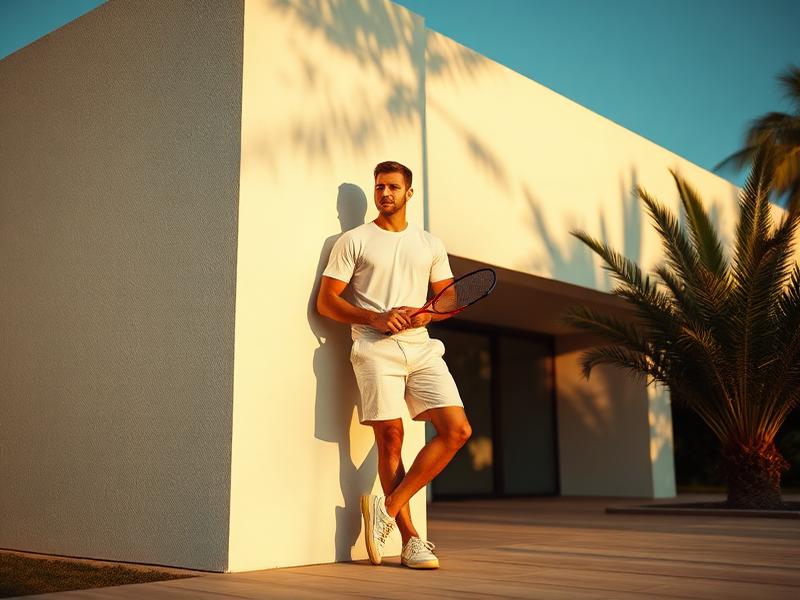
For men, a tailored performance tee or polo usually works best. A polo gives a more elevated club look, especially for mixed events, corporate padel days, or resort play. A tee feels more relaxed and modern. The key is fit: the shoulder seam should sit correctly, the body should not balloon, and the sleeves should allow full overhead motion. For women, fitted tanks, short-sleeve performance tops, and breathable polos all work, depending on personal preference. The best pieces stay in place during movement and do not require constant adjustment.
Color is where padel style becomes interesting. Traditional white always looks clean. Navy and black are easy, sophisticated bases. Olive, sand, slate, espresso, burgundy, and soft blue feel more distinctive without becoming loud. A strong padel brand can build an entire visual language around these tones. The goal is not to look like every other court sport. The goal is to create a look that feels athletic, international, and club-ready.
Padel bottoms must solve three problems: movement, comfort, and ball storage. Shorts should be light, flexible, and long enough to move confidently without excess fabric catching during lunges. A seven-inch or eight-inch inseam works for many men, while some prefer a slightly shorter cut for mobility. The waistband should stay secure without digging in. A stretch liner can be useful, but it should be breathable and not overly compressive.
Pockets are not a minor detail. Players need to hold at least one ball, and the pocket should keep it secure without creating a bulge that interferes with movement. Deep, angled pockets are useful. Zippered pockets are good for off-court life but can be annoying during play if a ball catches on the zipper. Brands should test pockets with actual padel balls, not just assume a tennis short pattern will work.
For women, skirts, skorts, dresses, shorts, and leggings can all work if they are designed for court movement. The most important features are coverage, secure ball storage, breathable compression, and a cut that allows quick directional changes. A skort with built-in shorts and a ball pocket can be ideal. Dresses can be stylish, but they must be performance-first, not simply fashion pieces with a court label.
Off-court, the same bottoms should transition well. This is where padel differs from many gym sports. The best shorts or skirts can be worn to coffee, lunch, or a resort lounge without looking like leftover workout gear. That is a major opportunity for padel apparel: build pieces that perform on the court but still belong in the rest of the player’s day.
A complete padel wardrobe needs layers. Warmups matter because padel players often go from sitting or driving directly into fast lateral movement. A light zip jacket, breathable quarter-zip, or technical overshirt helps the body warm gradually. After play, the same layer keeps the outfit polished and prevents the damp post-match look.
The best layers are lightweight, packable, and cut close enough to look sharp without restricting shoulders. A quarter-zip in navy, black, cream, or charcoal is one of the most versatile pieces a padel player can own. A technical hoodie can work for colder climates or relaxed clubs, but the fit should be clean. Oversized hoodies may be comfortable, but they rarely deliver the elevated padel aesthetic.
For travel, layers become even more important. A player going to a padel weekend or resort tournament should pack pieces that mix easily. A lightweight jacket can go over a polo, tee, or knit. A clean pair of technical pants can work for the flight, the club, and dinner. The goal is a capsule wardrobe: fewer pieces, better combinations, and less friction.
Accessories in padel should be useful first and stylish second. A cap or visor protects from sun and helps manage sweat. Wristbands can be practical in heat, especially for players who sweat heavily and need a dry grip. Socks should be cushioned enough for hard movement but breathable enough for long sessions. Thin lifestyle socks may look nice but often fail during repeated lateral play.
Sunglasses can be valuable outdoors, but they must stay stable during movement and offer good contrast. A player who constantly adjusts sunglasses loses focus. The same applies to jewelry. Minimal pieces are fine, but anything that swings, catches, or distracts should stay off court.
The padel bag is another style signal. A serious player does not need to carry a giant touring bag, but a well-designed padel bag helps organize rackets, shoes, water, towel, grips, sunscreen, and post-match clothing. For luxury or premium brands, the bag category is especially interesting. It is visible, functional, giftable, and closely tied to the club lifestyle.
Padel is as much about the hour after the match as the match itself. The conversation, the coffee, the drink, the handshake, the next game arranged on the spot – these are part of the sport’s appeal. Off-court style should respect that culture. The easiest formula is simple: keep the athletic base, add a refined layer, and switch one element if needed.
For men, a clean polo, performance short, and court shoe can become post-match appropriate with a lightweight overshirt or jacket. For a more elevated setting, switch into a casual sneaker or loafer and add a technical pant. For women, a court dress or skort can transition with a cropped jacket, overshirt, or relaxed knit. Neutral colors make this transition easier.
The mistake is over-styling. Padel culture values ease. The best dressed person at the club usually looks natural, not staged. They wear quality fabrics, simple shapes, good shoes, and one or two details that show personality. That might be a vintage-inspired cap, a textured jacket, a distinctive bag, or a signature color.
A great padel outfit changes with the environment. In hot climates like Miami, Dubai, Marbella, or Mexico, breathability and sun management are everything. Lightweight tops, caps, sweat-wicking socks, and extra shirts are essential. Dark colors may look sleek, but they can become punishing under direct sun. Light neutrals, white, pale blue, and sand tones perform better in heat.
In cooler climates, the challenge is staying warm without restricting movement. Players should avoid heavy cotton sweatshirts during play. Instead, use thin technical layers that can come off quickly. A breathable base layer under a polo or tee can work in winter. Technical pants should allow lunges and rotations. Gloves are rarely needed for play, but a warm layer for the walk to and from court can make a difference.
Indoor clubs create a different problem: temperature swings. A player may warm up in a cool facility and then overheat during long rallies. Layering is the solution. Choose pieces that can be removed easily and stored without wrinkling.
The list of mistakes is short but important. Do not wear running shoes if you plan to play seriously. Do not wear heavy cotton if you will sweat. Do not wear shorts without usable pockets unless you have another ball-storage solution. Do not wear overly loose clothing that catches during movement. Do not wear fragile fashion pieces and pretend they are sportswear. Do not wear anything that makes you think about your outfit more than the point.
There is also a branding mistake: copying tennis too closely. Padel borrows from tennis, but it is not tennis. A padel brand should not simply replicate heritage tennis whites and call it a day. The opportunity is to create a new court language: faster, more social, more international, more travel-driven, and more connected to modern athleisure.
A strong starter wardrobe for a regular player might include two performance tees, two polos, two pairs of court shorts or skorts, one lightweight jacket, one quarter-zip, three pairs of proper socks, one cap or visor, one pair of court shoes, and one padel bag. Add a dress, technical pants, or an extra layer depending on personal style and climate. The key is compatibility. Every top should work with every bottom. Every layer should work with the base colors. Every piece should have a reason to exist.
For a premium brand, this capsule can become the foundation of product strategy. Instead of launching random apparel, build around the player’s week: first lesson, league night, resort trip, corporate event, tournament weekend, and off-court social hour. Each product should solve a real moment in the padel lifestyle.
Court style is not only about clothing. It is about belonging. New sports grow faster when people can see themselves inside the culture. Padel has an advantage because its visual identity is attractive: glass courts, evening lights, doubles teams, resort backdrops, and social energy. Apparel gives that identity something people can buy, wear, share, and repeat.
The most successful padel brands will not sell shirts. They will sell the feeling of being part of a modern court club. They will understand that a player wants to look capable before they are great, comfortable before they are competitive, and polished without losing athletic credibility. They will design for the first-time player, the weekend regular, the traveling enthusiast, and the serious league competitor.
For clubs, the same logic applies. Staff uniforms, member merchandise, tournament gifts, and event apparel should reinforce the club’s personality. A cheap logo tee may check a box, but a beautiful performance polo or cap becomes part of a player’s weekly rotation. That is the difference between merchandise and brand equity.
The best padel style is practical, refined, and alive to the culture of the sport. It starts with court-specific footwear, breathable fabrics, secure pockets, and easy layers. It extends into bags, accessories, travel pieces, and off-court looks. Most importantly, it respects the player. Padel is active, social, competitive, and stylish. The wardrobe should be the same.
When you dress well for padel, you are not dressing for a photograph. You are dressing for movement, confidence, and the moments around the match. That is why court style matters. It helps the game feel better, and it helps the player feel like they belong.